Product Design
Redesigning hospital access in a country where healthcare was already fragile — then COVID hit.
00

problem
Punhlaing Hospital brought us in to solve a straightforward problem: healthcare in Myanmar was hard to access, and their patient experience was suffering for it. Rural infrastructure gaps, long wait times, no digital touchpoints — the brief was clear. Then COVID-19 arrived mid-project. Suddenly "improving hospital access" became "reimagining what a hospital visit even means." The constraints got harder. The stakes got higher. And the solution had to work for people who were now afraid to leave their homes.
solution
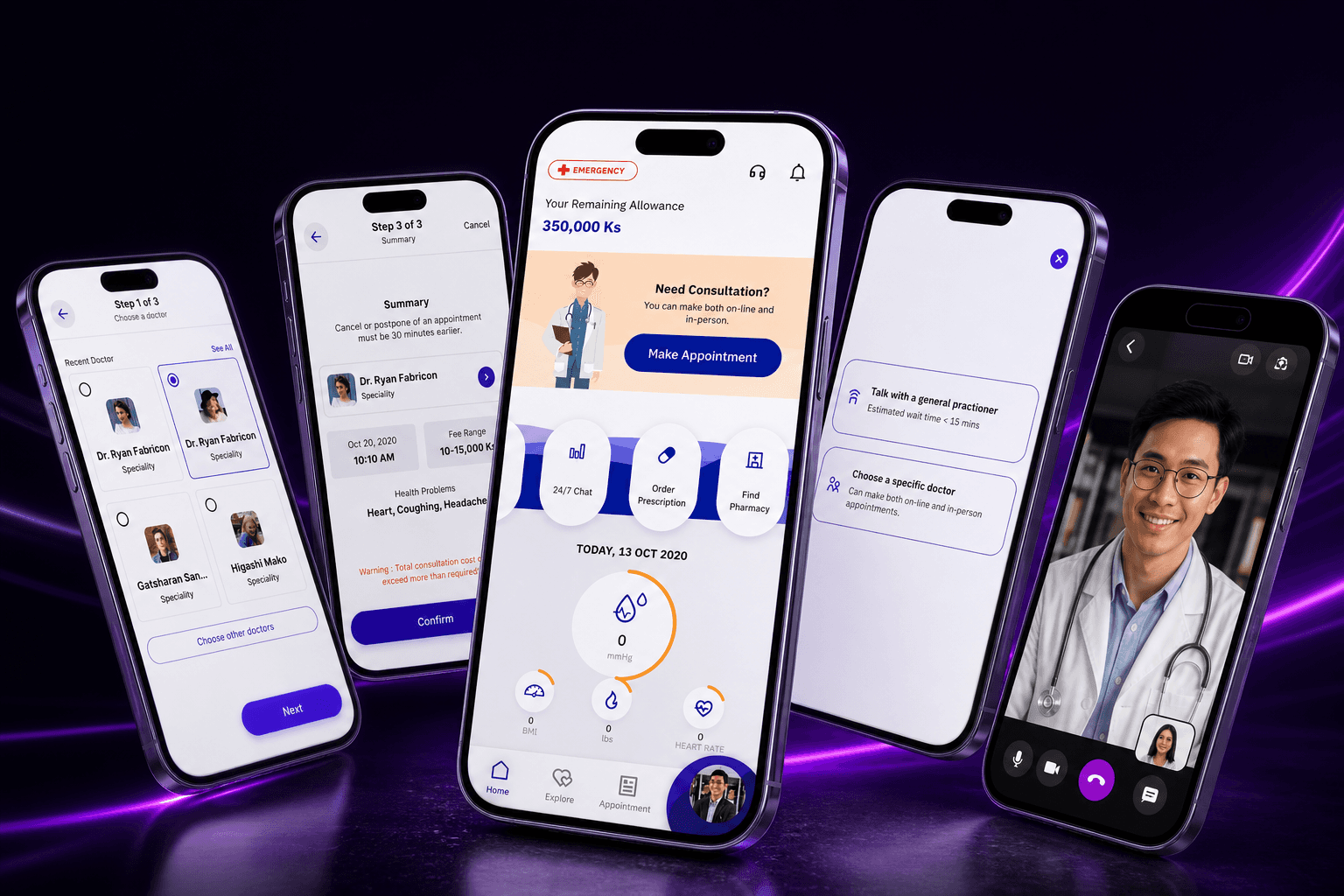
The research pointed clearly to a dual-sided problem — so we designed a dual-sided solution. For Patients — Mobile App Book appointments that fit real schedules. Review personal health history in one place. Order prescription deliveries (critical during lockdowns). Pay through an in-app wallet with no extra fees. And — the COVID pivot that became a core feature — virtual consultations for first screenings, saving patients the commute, cost, and anxiety of an unnecessary in-person visit. For Hospital Staff — Desktop Management System A workflow tool giving receptionists and doctors a shared, real-time view of appointment availability and patient data. What was previously a phone-and-paper process became a coordinated, legible system across the entire hospital.
We couldn't go on-site. So we ran the entire research phase remotely via Microsoft Teams — patients, doctors, pharmacists, receptionists, HR, nursing officers. 38 participants across three distinct groups, each with completely different needs and workflows.
The number that reframed everything: the majority of patients called ahead just to avoid a 2–3 hour wait. With a phone appointment, that dropped to 30–60 minutes. The desire to plan ahead was already there — the hospital just had no digital infrastructure to meet it.
Key pain points that kept surfacing across all groups:
Patients couldn't predict costs before showing up
Receptionists were managing doctor availability manually with zero visibility
Transportation and commute were real barriers, especially for older patients
Doctors had no streamlined way to access patient history before appointments
The problem wasn't that people didn't want better healthcare. It was that every touchpoint made it harder to get.
Finding Solution
How might we help patients make appointments in advance that fits their schedule
How might we design a workflow that can help the receptionists better appoint availability of the doctors and patients in person
The COVID layer
What could have derailed the project actually sharpened it. The pandemic forced every assumption about "going to the hospital" to be questioned. Virtual appointments weren't a nice-to-have — they became the feature that made the whole product relevant in 2020 and beyond.
Designing for telemedicine in a country with limited digital health literacy, under a tight two-month timeline, with fully remote research — that was the real design challenge. And it shaped every decision from information architecture to the tone of the UI copy.
Outcome
The app shipped on iOS and is live on the App Store. The hospital now runs appointment management through the desktop system. Patients can book, consult, review records, and pay — without setting foot inside unless they need to.
A two-month sprint that started as a UX improvement project ended up being infrastructure Myanmar's private healthcare sector didn't know it needed.
Product Design Director: NgeOo Mon — Research lead, synthesis, design direction, cross-functional coordination
year
2020
timeframe
16 days
tools
Figma
category
Product Design
01


